


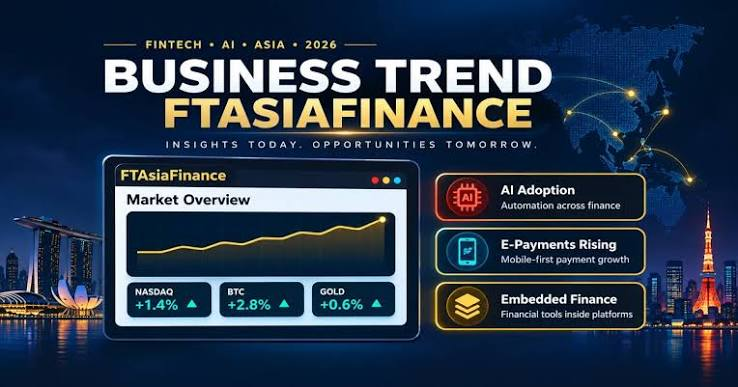
The financial world is changing quickly, and Asia is one of the most active regions in this transformation. New technologies are changing the way people pay, save, borrow, invest, and manage money. Businesses are also adopting digital financial tools to reduce costs, improve customer experiences, and reach markets that were previously difficult to serve. This is where the topic of ftasiafinance business trends from fintechasia becomes important for anyone interested in modern finance and technology.
FTAsiaFinance business trends from FintechAsia can be understood as a broad look at the developments shaping Asian fintech, including digital banking, mobile payments, artificial intelligence, blockchain, open finance, investment technology, and financial inclusion. These developments are not happening separately. They are increasingly connected, creating a financial ecosystem in which banks, fintech startups, technology companies, investors, regulators, and consumers influence one another.
The growth of fintech in Asia has also changed what businesses expect from financial services. Customers want faster payments, convenient digital accounts, secure transactions, and services that work smoothly across different platforms. At the same time, companies need stronger cybersecurity, regulatory compliance, reliable infrastructure, and sustainable business models. Understanding these changes can help businesses and professionals make more informed decisions as financial technology continues to develop.
Quick Facts
| Field | Details |
|---|---|
| Topic | FTAsiaFinance Business Trends from FintechAsia |
| Main Focus | Finance, fintech, business, and technology |
| Region | Asia and global financial markets |
| Key Areas | Digital banking, fintech, AI, blockchain, payments |
| Business Focus | Market trends, financial innovation, and growth |
| Technology Focus | AI, automation, blockchain, and digital finance |
| Related Topics | Fintech trends, financial technology, investment, digital transformation |
| Target Audience | Investors, businesses, fintech professionals, and general readers |
| Platform | FTAsiaFinance.net |
| Content Style | Finance, business, technology, and market insights |
What Does FTAsiaFinance Business Trends from FintechAsia Mean?
The phrase ftasiafinance business trends from fintechasia is generally associated with the changing relationship between finance, technology, and business across Asian markets. It covers a wide range of subjects rather than one single financial product. Digital banking, fintech investment, mobile payments, artificial intelligence, blockchain, financial inclusion, and emerging financial infrastructure all form part of the wider conversation. FTAsiaFinance business trends from FintechAsia.
The specific relationship between websites or organizations using the names FTAsiaFinance and FintechAsia should be treated carefully because similarly named platforms can appear online. The FTAsiaFinance page associated with this keyword presents the subject as a discussion of financial innovation and Asian fintech developments. Therefore, readers should distinguish between information published by a particular website and independently verified market data from regulators, financial institutions, or established research organizations. FTAsiaFinance business trends from FintechAsia.
From an SEO and research perspective, the keyword is also interesting because people may use it while looking for information about Asian fintech trends rather than simply searching for a company profile. Related searches can include Asian fintech trends, fintech business trends, digital finance in Asia, financial technology trends, digital banking, fintech investment, AI in finance, blockchain finance, and financial innovation. FTAsiaFinance business trends from FintechAsia.

Digital Banking Is Changing the Financial Experience
Digital banking is one of the most visible developments connected with modern fintech. Traditional banking once required customers to visit branches for many routine services, but mobile applications and online banking platforms have moved a large part of the banking experience to smartphones and computers. Customers can increasingly check balances, transfer money, pay bills, manage cards, and access financial products without visiting a physical branch. FTAsiaFinance business trends from FintechAsia.
This transformation is particularly important in Asian markets because many consumers are already comfortable with mobile-first services. Digital banks and fintech applications can provide convenient interfaces while using cloud infrastructure, APIs, data analytics, and automated processes behind the scenes. The result is a banking experience that can be faster and more closely connected with the digital habits of customers. FTAsiaFinance business trends from FintechAsia.
However, digital banking is not simply about creating a mobile application. Financial institutions must also manage cybersecurity, identity verification, fraud prevention, regulatory requirements, customer support, and operational resilience. As the sector becomes more competitive, sustainable revenue and customer trust are becoming increasingly important. A digital financial service needs reliable infrastructure and a clear business model in addition to attractive technology. FTAsiaFinance business trends from FintechAsia.
Real-Time Payments Are Becoming Financial Infrastructure
Real-time payments have become an important part of the Asian fintech landscape. Consumers increasingly expect money to move quickly, whether they are paying a merchant, sending money to another person, purchasing something online, or receiving funds from a business. Payment networks and digital wallets are therefore becoming more than simple transaction tools. FTAsiaFinance business trends from FintechAsia.
The growth of instant payment infrastructure also creates opportunities for businesses. Companies can connect payments with accounting systems, online marketplaces, subscription services, invoicing platforms, lending products, and customer loyalty programs. Once transactions become faster and more digital, other financial services can be developed around the payment relationship. FTAsiaFinance business trends from FintechAsia.
This trend also demonstrates why interoperability matters. Different countries have developed their own payment systems, but cross-border commerce requires greater connectivity between markets. The development of regional payment links and digital payment standards could make international transactions easier while also creating new opportunities for fintech companies that build infrastructure around payments. FTAsiaFinance business trends from FintechAsia.
Artificial Intelligence Is Moving Into Financial Services
Artificial intelligence is another major part of ftasiafinance business trends from fintechasia. Financial institutions and fintech companies are exploring AI for customer service, fraud detection, risk assessment, document processing, compliance operations, financial analysis, and other repetitive or data-intensive activities. AI can process large quantities of information quickly, making it useful in environments where organizations handle millions of transactions and customer interactions. FTAsiaFinance business trends from FintechAsia.
One important area is fraud prevention. Financial institutions have to identify unusual transaction patterns while allowing legitimate customers to complete payments without unnecessary interruptions. Machine-learning systems can examine transaction behavior and identify signals that may require additional review. Similar technology can also support anti-money-laundering processes and other compliance activities, although human oversight remains important. FTAsiaFinance business trends from FintechAsia.
Generative AI is expanding the conversation even further. Financial companies are experimenting with AI assistants, automated document analysis, internal knowledge tools, and personalized customer communication. At the same time, financial organizations have to consider privacy, accuracy, security, explainability, and regulatory expectations. AI adoption therefore involves more than purchasing software; it requires appropriate governance and careful implementation. FTAsiaFinance business trends from FintechAsia.
Open Finance and Financial Data Are Creating New Opportunities
Open finance is another important development in the Asian financial technology ecosystem. Traditional financial services often kept customer information within individual institutions. Open finance aims to create controlled ways for customers to authorize the sharing of financial information between providers, potentially allowing different financial services to work together more effectively. FTAsiaFinance business trends from FintechAsia.
When implemented with appropriate consent and security controls, open finance can support more personalized financial products. A customer could potentially allow an authorized provider to access relevant financial information and use it to help understand spending patterns, assess eligibility, or offer financial management tools. Businesses can also benefit when financial data becomes easier to connect across systems. FTAsiaFinance business trends from FintechAsia.
However, financial data is highly sensitive, which means open finance requires strong privacy and cybersecurity protections. Customers need to understand who is accessing their information, why it is being accessed, and how it will be used. Regulations and technical standards therefore play an important role in determining how quickly open finance develops across different Asian markets.

Embedded Finance Is Bringing Financial Services Into Everyday Platforms
Embedded finance describes the integration of financial services directly into non-financial products and platforms. Instead of visiting a traditional bank separately, a customer might encounter payment, lending, insurance, or other financial functionality while using an e-commerce platform, business software, transportation application, or digital marketplace.
This model can change the relationship between businesses and financial institutions. A technology company does not necessarily need to become a traditional bank to provide a financial feature. Through partnerships, APIs, banking infrastructure, and regulated financial providers, businesses can integrate selected financial services into their existing customer experiences.
For customers, the attraction is convenience. A financial service becomes available where the customer already needs it. For businesses, embedded finance can create additional revenue opportunities and strengthen customer relationships. Nevertheless, companies must understand the regulatory responsibilities associated with financial products. Convenience cannot replace proper consumer protection, security, transparency, and compliance.
Blockchain and Tokenisation Are Developing Beyond Cryptocurrency
Blockchain continues to influence financial technology discussions, although its role extends beyond cryptocurrency. One area receiving attention is tokenisation, in which assets or financial instruments can be represented digitally on blockchain-based systems. This concept has attracted interest because it may support new ways of managing ownership, settlement, and financial transactions.
Tokenisation could potentially be applied to different forms of financial or real-world assets, depending on the legal and technological framework. Financial institutions are examining whether blockchain-based infrastructure can improve settlement processes, reduce operational friction, or create new forms of digital financial products.
The development of blockchain finance also depends heavily on regulation. Financial institutions cannot treat blockchain technology as a replacement for compliance requirements. Issues such as customer identification, asset ownership, consumer protection, cybersecurity, taxation, and cross-border regulation remain important. As a result, the future of blockchain in finance is likely to depend on how effectively technological innovation can operate within established legal and financial systems.
Fintech Investment Is Becoming More Focused on Sustainable Growth
Fintech investment has changed significantly from the period when startups could attract large amounts of funding primarily through rapid customer acquisition and aggressive expansion. Investors are increasingly interested in sustainable revenue, customer retention, efficient operations, regulatory readiness, and a realistic path toward profitability.
This does not mean investment in fintech has stopped. Instead, the investment environment has become more selective. Companies offering useful infrastructure, strong payment technology, effective financial software, cybersecurity solutions, AI applications, or services addressing genuine customer needs may continue to attract attention when they can demonstrate a sustainable business model.
For fintech founders, this creates a stronger need for financial discipline. A promising technology must solve a real problem and generate measurable value. Businesses need to understand their customer acquisition costs, revenue sources, operating expenses, retention rates, regulatory obligations, and scalability. The ability to grow responsibly can be just as important as the ability to grow quickly.
Financial Inclusion and Cross-Border Finance Remain Important
One of the most significant promises of fintech is greater financial inclusion. Digital wallets, mobile payments, online lending platforms, digital banking, and alternative financial services can help people access financial products without depending entirely on traditional branch-based banking systems. This can be particularly relevant in regions where large populations have historically had limited access to formal financial services.
Fintech can also support small businesses. Digital payment systems can make it easier for merchants to receive money, while digital records may help businesses demonstrate transaction histories when seeking financial services. Online financial tools can also simplify accounting, invoicing, payments, and cash-flow management for smaller companies.
Cross-border finance is another important area. International businesses and consumers need payment systems that are fast, transparent, secure, and reasonably efficient. Greater connectivity between national payment networks could support regional commerce, tourism, remittances, and online business. At the same time, cross-border finance introduces additional regulatory, currency, compliance, and cybersecurity challenges that fintech companies must address.
What These Fintech Trends Mean for Businesses
The biggest lesson from ftasiafinance business trends from fintechasia is that technology should be connected to a genuine business need. Companies do not need to adopt every new financial technology simply because it is receiving attention. Instead, they should examine whether a particular tool can improve payments, reduce operating costs, strengthen security, improve customer service, or create a useful new revenue opportunity.
Businesses should also pay close attention to cybersecurity and data protection. As more financial activity becomes digital, the consequences of weak security can become more serious. Strong authentication, access controls, employee awareness, monitoring, secure software practices, and appropriate data governance are increasingly important parts of modern financial operations.
The broader Asian fintech market is also becoming more interconnected. Banks, fintech startups, technology companies, payment networks, regulators, and investors all influence the direction of the industry. Companies that understand this ecosystem can better recognize where opportunities exist and where risks may emerge. Sustainable fintech growth will depend on combining innovation with trust, security, compliance, and practical business value.

Conclusion
FTAsiaFinance business trends from FintechAsia provide a useful way to explore the major forces changing financial technology across Asia. Digital banking, real-time payments, artificial intelligence, open finance, embedded finance, blockchain, tokenisation, financial inclusion, and cross-border payments are all contributing to a rapidly changing financial environment.
The most important development is not simply the introduction of new technology. The larger transformation is the way technology is becoming part of everyday financial infrastructure. Payments are becoming faster, banking services are becoming more digital, financial data is becoming more connected, and businesses are finding new ways to integrate financial products into customer experiences.
At the same time, responsible growth remains essential. Financial technology operates in a highly sensitive environment where security, privacy, regulation, consumer protection, and trust matter as much as innovation. Companies that understand these requirements can approach fintech opportunities more thoughtfully and build services designed for long-term use.
As Asian economies continue to digitize, the relationship between finance and technology is likely to become even stronger. Following ftasiafinance business trends from fintechasia can therefore help readers understand not only what is changing in fintech today, but also why digital financial infrastructure, responsible innovation, and customer-focused technology are becoming increasingly important to the future of business.
