


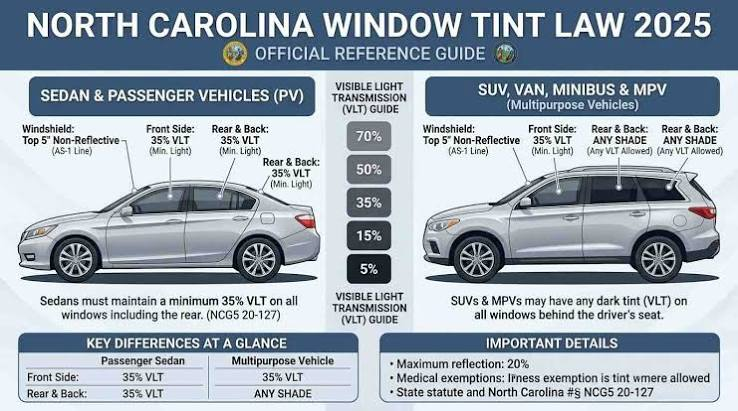
North Carolina window tint laws changed in important ways during 2025, and those changes continue to affect drivers in 2026. The biggest change is that window tint is no longer checked as part of the regular North Carolina vehicle safety inspection. However, this does not mean that drivers can install any darkness of tint they want. The legal limits for window tint remain in place, and law enforcement can still enforce those requirements.
The changes came through Session Law 2025-47, which was enacted from Senate Bill 391. One section removed the required window-tint inspection from the annual safety inspection beginning December 1, 2025. The same legislation also introduced a requirement for drivers with North Carolina Window Tint Law Changes to roll down the window when a law enforcement officer approaches. Another provision increased the maximum number of medical exception permits that a person can have from two to four.
North Carolina Window Tint Law Quick Facts
| Quick Fact | Details |
|---|---|
| State | North Carolina |
| Main Law | North Carolina General Statute §20-127 |
| Major Recent Change | Window tint checks removed from routine safety inspections |
| Effective Date | December 1, 2025 for the inspection and officer-window provisions |
| Standard Tint Requirement | Windows generally must meet North Carolina’s visible-light-transmission requirements |
| Enforcement | Tint can still be enforced during traffic stops |
| Windshield Tint | Limited to the upper portion of the windshield |
| Medical Exception | Available for qualifying photosensitivity conditions |
| Medical Permit Change | Maximum increased from two to four permits |
| Driver Requirement During Approach | Driver must roll down the appropriate window when approached by law enforcement |
| Current Status | Changes remain relevant in 2026 |
What Changed in North Carolina Window Tint Laws
The most noticeable North Carolina window tint law change took effect on December 1, 2025. Before the change, window tint was part of the state’s safety inspection process. Inspectors could determine whether aftermarket tint had been installed and use an approved light meter to check whether it complied with the state’s restrictions. The new law removed that tint-check requirement from the safety inspection. North Carolina Window Tint Law Changes.
The important point is that removing the inspection requirement did not remove the tint law itself. North Carolina General Statute §20-127 still establishes restrictions for vehicle window tint. Therefore, a vehicle can potentially pass its safety inspection without a tint measurement while still having tint that does not comply with state law. This distinction is one of the most important things drivers need to understand about the recent changes. North Carolina Window Tint Law Changes.
Is Window Tint Still Legal in North Carolina?
Yes, window tint remains legal in North Carolina when it meets the requirements established by state law. The current statute generally requires tinted vehicle windows to meet a minimum light-transmission standard and limits their reflectance. The law also restricts certain tint colors and requires tinting material to be nonreflective. North Carolina Window Tint Law Changes.
North Carolina’s statutory language can be confusing because it refers to total light transmission of at least 35 percent, while also providing that a window measuring more than 32 percent with an approved light meter is conclusively presumed to comply with that restriction. This means drivers should not interpret the new inspection change as permission to use extremely dark tint. The safest approach is to have aftermarket film professionally measured and installed according to the applicable North Carolina requirements. North Carolina Window Tint Law Changes.
North Carolina Tint Percentage Requirements
For most vehicle windows covered by the standard rule, North Carolina law establishes a visible-light-transmission requirement. The statute says total light transmission must be at least 35 percent, while a measurement above 32 percent using an approved meter is conclusively presumed to satisfy that restriction. This distinction is important when people compare North Carolina’s rules with tint laws in other states, because different states can use different measurement standards and terminology. North Carolina Window Tint Law Changes.
The law also addresses reflectance. Tinted windows may not have light reflectance above 20 percent, and the tinting material must be nonreflective and cannot be red, yellow, or amber. Consequently, choosing a film based only on how dark it looks is not enough. The film’s actual measured light transmission and other characteristics matter when determining compliance. North Carolina Window Tint Law Changes.
Windshield Tint Rules in North Carolina
North Carolina treats the windshield differently from other vehicle windows. Under General Statute §20-127, tinting on the windshield is limited to the upper portion. The tint cannot extend more than five inches below the top of the windshield or below the AS1 line, whichever measurement is longer. The statute also provides for an untinted clear film that does not obstruct vision and is designed to reduce or eliminate ultraviolet radiation entering the vehicle. North Carolina Window Tint Law Changes.
This means a driver should not assume that the same tint percentage used on side or rear windows can simply be applied across the entire windshield. Windshield tint has its own restrictions. Drivers considering windshield film should therefore make sure the installer understands the North Carolina requirements rather than relying on a generic tint package designed for another state. North Carolina Window Tint Law Changes.
What the 2025 Inspection Change Means for Drivers
One of the biggest practical effects of the new law is that window tint is no longer a required part of North Carolina’s annual safety inspection. The North Carolina Department of Transportation confirms that, as of December 1, 2025, window-tint checks are no longer required during safety inspections, and the additional $10 window-tint inspection fee was eliminated.
This change may make the inspection process simpler for vehicle owners with aftermarket tint, but it does not provide a legal exemption from the underlying tint restrictions. The state continues to direct drivers to General Statute §20-127 for the requirements governing aftermarket tint. In other words, inspection and legality are now more clearly separated: a vehicle may no longer receive a tint measurement during the routine inspection, but an unlawful tint can still create a separate legal issue. North Carolina Window Tint Law Changes.
New Requirement to Roll Down Tinted Windows
Another significant change became effective December 1, 2025. Under the amended law, a driver of a vehicle with tinted windows must roll down the driver’s-side window when a law enforcement officer approaches. If the officer approaches from the passenger side, the driver must roll down the passenger window instead. North Carolina Window Tint Law Changes.
The provision is intended to address visibility during interactions between drivers and law enforcement. The requirement is separate from the percentage limits for window tint, so drivers should understand both rules. Having legal tint does not remove the obligation to lower the appropriate window when an officer approaches, and the removal of the inspection requirement does not eliminate this new traffic-stop requirement. North Carolina Window Tint Law Changes.
Medical Exception Changes for Window Tint
North Carolina also changed its medical exception rules in 2025. Under the amended law, a person with a medical condition that causes photosensitivity to visible light may apply for a medical exception permit through the state’s Drivers Medical Evaluation Program. The legislation increased the maximum number of valid medical exception permits a person may have at one time from two to four. This portion of the law became effective July 1, 2025. North Carolina Window Tint Law Changes.
A medical exception does not simply allow unlimited tint without documentation. The permit process requires medical certification and specifies the vehicle, windows, and permitted tint levels. The permit must be carried in the vehicle, and North Carolina also provides for a sticker identifying the vehicle as having a medical exception. The state’s current waiver materials continue to provide instructions for applicants and physicians. North Carolina Window Tint Law Changes.
What Happens If Your Tint Is Too Dark?
Although the inspection requirement has changed, North Carolina’s statute continues to establish consequences for unlawful window tint. General Statute §20-127 states that applying noncompliant tint to a vehicle subject to state inspection and driving a vehicle with a window that does not meet the restrictions can constitute a Class 3 misdemeanor. North Carolina Window Tint Law Changes.
The law also provides a specific defense involving removal of unlawful tint. A person charged with driving a vehicle with an unlawfully tinted window may have a defense if the tint is removed within 15 days after the charge and the window is subsequently shown to comply with the requirements. The statute specifies documentation from the Division of Motor Vehicles or Highway Patrol for this purpose. Because enforcement circumstances can vary, drivers facing an actual citation should rely on official state information or qualified legal advice rather than assuming that removing the tint automatically resolves every issue. North Carolina Window Tint Law Changes.
How Drivers Can Stay Compliant in 2026
The simplest way to approach North Carolina’s updated tint rules is to separate three different questions: whether the tint is within the legal limits, whether the vehicle needs a routine inspection tint check, and what the driver must do during a traffic stop. The first remains important because the tint law is still in effect. The second changed on December 1, 2025, because tint checks were removed from the required safety inspection. The third changed at the same time through the new window-lowering requirement. North Carolina Window Tint Law Changes.
Drivers installing new film should have the tint professionally measured rather than relying on a film’s marketing percentage alone. Factory-installed glass and aftermarket film can affect the final amount of visible light transmission, so the final result may differ from the percentage printed on the film packaging. Keeping documentation related to a medical exception, when applicable, is also important. These basic steps can help vehicle owners understand the difference between passing an inspection and actually complying with North Carolina’s tint requirements. North Carolina Window Tint Law Changes.
North Carolina Window Tint Law Changes: What to Remember
The North Carolina window tint law changes introduced in 2025 did not make dark window tint generally legal. Instead, they changed how tint is handled during safety inspections and introduced a new requirement for drivers during encounters with law enforcement. Since December 1, 2025, window tint is no longer part of the required safety inspection, and the separate $10 tint inspection fee has been eliminated. Nevertheless, the underlying tint restrictions under G.S. 20-127 remain in effect.
The medical exception rules also changed, with the maximum number of valid permits increasing from two to four beginning July 1, 2025. For drivers in 2026, the key is to understand that inspection rules and tint legality are not the same thing. Checking the actual requirements before installing aftermarket film, understanding the windshield restrictions, and following the window-lowering requirement during a law-enforcement approach can help vehicle owners navigate the updated North Carolina window tint laws with fewer surprises.
