


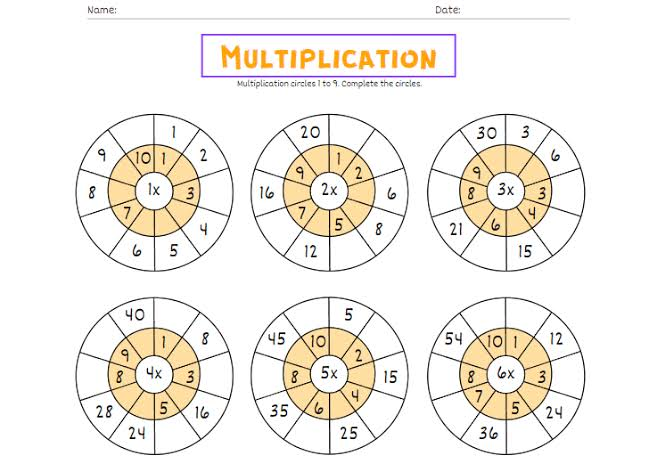
Year 3 maths worksheets are useful educational resources designed to help children develop essential mathematical skills through simple exercises and engaging activities. These year 3 maths worksheets cover important topics such as addition, subtraction, multiplication, division, fractions, shapes, measurements, and problem-solving. They provide students with opportunities to practise classroom lessons, improve number skills, and build confidence in mathematics.
Quick Facts
| Category | Details |
|---|---|
| Main Keyword | Year 3 Maths Worksheets |
| Age Group | 7–8 Years |
| Grade Level | Year 3 |
| Subject | Mathematics |
| Main Topics | Addition, Subtraction, Multiplication |
| Other Topics | Fractions, Geometry, Measurement |
| Worksheet Format | Printable PDF |
| Learning Purpose | Maths Practice |
| Suitable For | Home and Classroom |
What Are Year 3 Maths Worksheets?
Year 3 maths worksheets are educational practice sheets created for children who are developing their mathematical knowledge in primary school. They introduce important concepts through calculations, number activities, word problems, and visual exercises. These worksheets help students understand mathematical rules and apply them to different situations. year 3 maths worksheets.
At this stage, children begin working with larger numbers and more challenging calculations. They also learn multiplication tables, basic division, fractions, measurements, and geometric shapes. Regular worksheet practice helps reinforce these concepts and prepares students for more advanced mathematics.
Year 3 Addition and Subtraction Worksheets
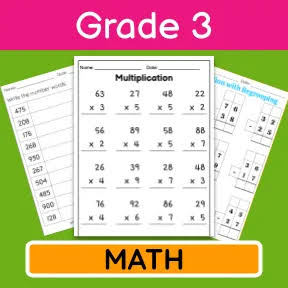
Addition and subtraction are important mathematical skills that Year 3 students need to practise regularly. Worksheets often include two-digit and three-digit calculations, missing-number questions, and exercises involving regrouping. These activities help children understand how numbers work together and improve calculation accuracy. year 3 maths worksheets.
Word problems are another useful addition to these worksheets. Students may calculate the total cost of several items, find the difference between two quantities, or work out how many objects remain after some are removed. Such exercises help children connect mathematics with everyday situations. year 3 maths worksheets.
Year 3 Multiplication Worksheets
Multiplication worksheets introduce children to repeated addition and multiplication facts. Students practise multiplication tables, especially the 2, 3, 4, 5, 8, and 10 times tables, while learning how to calculate products accurately. year 3 maths worksheets.
Picture-based multiplication activities can make the subject easier to understand. For example, children may count groups of apples, pencils, or toys to find the total number of objects. These exercises develop number sense and help students become more confident with multiplication.
Year 3 Division Worksheets
Division worksheets teach students how to share quantities equally and understand basic division calculations. Children practise dividing numbers into equal groups and recognising the relationship between multiplication and division.
Simple exercises may involve sharing 24 sweets equally among four children or arranging 30 objects into groups of five. These practical examples help learners understand division as a real-life mathematical skill rather than simply memorising calculations.
Year 3 Fractions Worksheets
Fractions are an important part of the Year 3 mathematics curriculum. Children begin learning how to recognise and understand simple fractions, including halves, thirds, quarters, and unit fractions. Worksheets often use pictures of pizzas, circles, rectangles, and other objects to explain how a whole can be divided into equal parts.
Students can also practise identifying fractions of shapes and quantities. For example, they may colour one-quarter of a shape or find half of a group of 12 objects. These activities develop a strong foundation for more advanced fraction concepts.
Year 3 Time, Money, and Measurement Worksheets
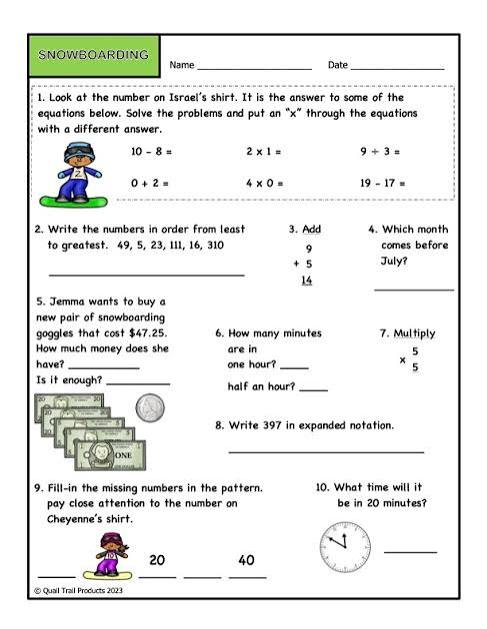
Time and measurement worksheets help children understand practical mathematical concepts. Students learn to read clocks, identify hours and minutes, calculate simple time intervals, and recognise different units of measurement.
Money worksheets introduce coins, notes, totals, and simple calculations involving prices. Measurement activities cover length, mass, capacity, and comparisons between different quantities. These exercises help children apply mathematical knowledge to everyday experiences.
Year 3 Shapes and Geometry Worksheets
Geometry worksheets introduce children to common two-dimensional and three-dimensional shapes. Students learn to recognise circles, triangles, squares, rectangles, cubes, cuboids, spheres, and cylinders.
Other activities involve identifying sides, corners, faces, and basic symmetry. Children may also complete shape patterns, match objects with their geometric names, and classify shapes according to their properties. These exercises develop visual understanding and spatial awareness.
Year 3 Word Problems and Mental Maths
Word problems encourage children to use mathematical knowledge to solve practical questions. They may involve shopping, sharing objects, measuring distances, counting collections, or calculating time. Students need to understand the question, identify the relevant information, and select the correct mathematical operation.
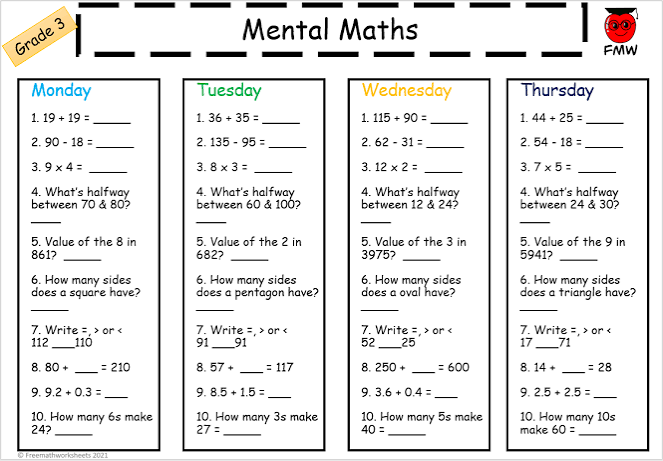
Mental maths worksheets provide opportunities to practise calculations without relying on written methods. Quick addition, subtraction, multiplication, and number-sequence activities improve calculation speed and confidence. Regular short practice sessions can help children become more comfortable with numbers.
How to Use Year 3 Maths Worksheets Effectively
Parents and teachers can use Year 3 maths worksheets to support classroom learning and home practice. It is helpful to begin with topics children already understand before introducing more challenging exercises. This approach allows students to build confidence while gradually developing new mathematical skills.
Children should also be encouraged to understand their mistakes instead of simply correcting answers. Parents can explain difficult questions using everyday objects, drawings, and simple examples. A balanced combination of worksheets, games, practical activities, and regular revision can make mathematics easier and more enjoyable.
Conclusion
Year 3 maths worksheets provide valuable opportunities for children to practise essential mathematical skills. From addition and subtraction to multiplication, division, fractions, geometry, and measurement, these activities support learning across important areas of mathematics.
Whether used at school or home, regular worksheet practice can improve accuracy, logical thinking, and problem-solving abilities. Choosing age-appropriate exercises and encouraging children to learn at their own pace can help build a strong foundation for future mathematics lessons.
